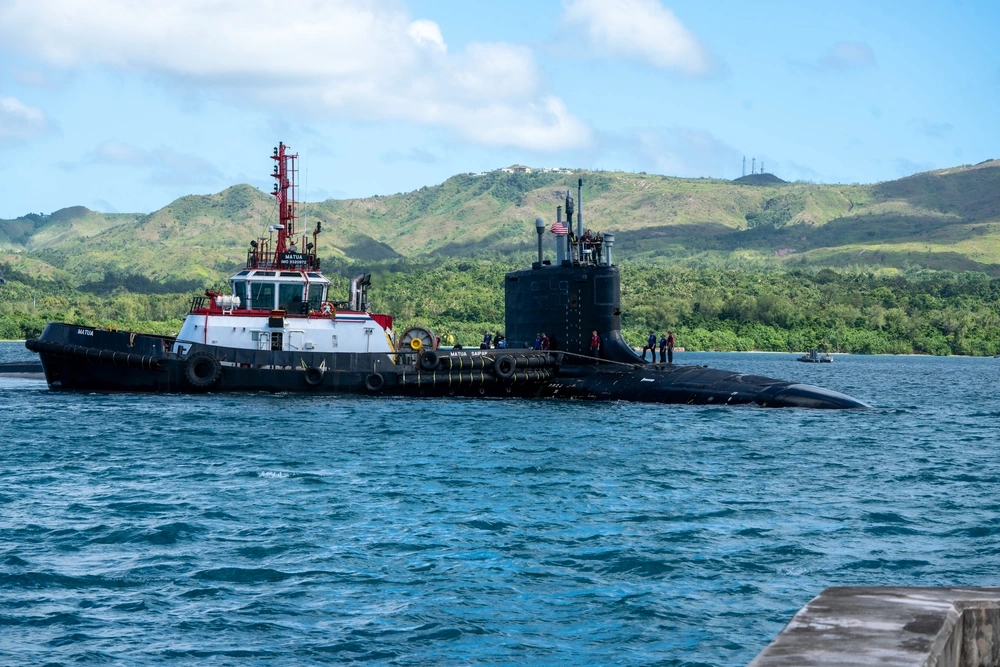
USS Vermont (SSN-792) is the first commissioned Block IV Virginia-class submarine Australia may receive in the future. Credit: Defense Visual Information Distribution System
Replacing Australia’s one new-build Virginia with a third used boat looks like streamlining – but it converts the fleet’s only appreciating asset into a depreciating one, and the reason isn’t simplicity.
On May 30, 2026, at the IISS Shangri-La Dialogue in Singapore, Australia, the United States, and the United Kingdom revised the AUKUS Pillar 1 submarine pathway. 1 Under the 2023 plan, Australia was to receive three Virginia-class attack submarines beginning in 2032: two used boats drawn from the U.S. Navy and one newly built Virginia delivered around 2038. 2 The revised arrangement keeps the number at three and deletes the new boat. All three will now come from the existing U.S. Navy inventory, drawn from the same Block IV production run. 3 Australian Defence Minister Richard Marles called the change a source of “significant” savings that would not alter the program’s overall cost. 4
For five years, the official line on AUKUS Pillar 1 has been that fleet commonality is the prize: one class, one supply chain, one training pipeline. The commonality argument is true and it is a distraction. A Virginia reactor is fueled once with highly enriched uranium and never refueled; the core’s life is the hull’s life. The deleted boat was the only one in Australia’s three that would have arrived with a full 33-year service life and an untouched core. The swap didn’t streamline Australia’s submarine force. It disguised America’s inability to build one.
Start with what Australia gave up. Virginia-class boats are designed for roughly 33 years of service, and because the HEU reactor is sealed for life, a boat’s remaining reactor life sets a hard ceiling on how long any new owner can sail it. 5 The original pathway intended to transfer used boats with around 20 years of life left – and to backstop them with one new Block VII whose clock had not yet started. The first Block IV commissioned in 2020 and the last will commission around 2026 so the used boats that reach Australian service will have somewhere between six and fifteen years already spent. Every year burned in U.S. service is a year Australia paid for and will never sail. Deleting the new hull doesn’t change the headcount; it changes the depreciation schedule of the entire fleet.
The reason for the deletion is not simplicity. The U.S. submarine industrial base cannot build the boats it has already promised. Virginia production has never reached its planned two-per-year rate. 6 Since 2022, production has run at about 1.1 to 1.2 boats annually, and it has fallen so far behind that the Navy bought a single Virginia in FY2025 against a planned two – even as the Pentagon’s own nominee for Indo-Pacific affairs acknowledges that honoring AUKUS while refilling American piers requires the rate to climb from 1.2 to 2.33 boats per year, a number the production line has never approached. 7 8 A new boat for Australia in 2038 would have to come out of a backlog the U.S. is already failing to clear. Faced with promising a hull it cannot build, Washington offered Canberra a third hull it already has. That is a production failure wearing a logistics costume.
Four discrepancies separate the streamlining story from the procurement reality. First, the swap trades a future appreciating asset for a present depreciating one – a fresh core for a partially spent one. Second, it converts a phased fleet, with older boats arriving now and one young boat arriving later, into a uniformly aging fleet that reaches end-of-life inside a narrower window in the 2050s and compresses the replacement bill. Third, it loads worn hulls onto an immature sustainment base, because Australia is standing up sovereign maintenance through ASC and BAE Systems at Henderson and Osborne and has committed A$12 billion to the Henderson hub – and used Block IV boats arrive after their first deep-maintenance period needing yard time immediately, the maintenance-sovereignty problem of inherited service histories and parts chains calibrated to American rather than Australian requirements. 9 10 11 Fourth, the revised statement quietly dropped the standing option for two additional Virginias, the hedge meant to cover SSN-AUKUS delays. Australia lost its newest boat and its insurance policy in the same communiqué.
It is true that three boats of one block are genuinely easier to crew, train for, and sustain than two of one configuration and one of another. Block IV and Block VII are separated by the Virginia Payload Module, the largest structural change in the class’s history, so a single-block fleet does narrow the parts tail. 12 The objection is correct and beside the point. The argument was never that commonality is fake; it is that commonality was the cheap benefit available to dress up an expensive concession. Canberra did not choose three identical boats because three identical boats were the optimal force. It accepted them because the alternative – the new boat it was promised – could not be built on schedule. Commonality then becomes the consolation prize.
References
1. Brahy, Jérôme. “Why Australia Dropped New Virginia-Class Submarines for Three Used US Navy Units in New AUKUS Plan.” Army Recognition, June 2, 2026. https://www.armyrecognition.com/news/navy-news/2026/revised-aukus-plan-australia-second-hand-us-submarines.
2. Eckstein, Megan. “Here’s When the US Navy Plans to Sell Subs to Australia Under AUKUS.” Navy Times, Nov. 16, 2023. https://news.yahoo.com/us-navy-plans-sell-subs-194012376.html.
3. Chomsky, Martin. “Australia to Buy Three Used U.S. Virginia-Class Submarines Under Streamlined AUKUS Acquisition Plan.” Defence Industry Europe, May 31, 2026. https://defence-industry.eu/australia-to-buy-three-used-u-s-virginia-class-submarines-under-streamlined-aukus-acquisition-plan/
4. Dziedzic, Stephen. “Australia to Buy Three Second-Hand United States Submarines Under AUKUS Shake-Up.” ABC News, May 31, 2026. https://www.abc.net.au/news/2026-05-31/australia-to-buy-second-hand-united-states-submarines-aukus/106742496
5. Luck, Alex. “AUKUS Partners Announce Changes to Submarine Agreement, Launch Joint Development for Underwater Drone Payloads.” Naval News, May 31, 2026. https://www.navalnews.com/naval-news/2026/05/aukus-partners-announce-changes-to-submarine-agreement-launch-joint-development-for-underwater-drone-payloads/
6. O’Rourke, Ronald. Navy Virginia-Class Submarine Program and AUKUS Submarine (Pillar 1) Project: Background and Issues for Congress. Congressional Research Service, Jan. 26, 2026. https://www.congress.gov/crs-product/RL32418
7. U.S. Naval Institute Staff. “Report to Congress on the Virginia-Class Submarine Program and AUKUS Pillar I.” USNI News, Jan. 27, 2026. https://news.usni.org/2026/01/27/report-to-congress-on-the-virginia-class-submarine-program-and-aukus-pillar-i
8. Brunnstrom, David, and Idrees Ali. “Pentagon Nominee Says Review Continuing on AUKUS Submarine Project.” Reuters, Oct. 7, 2025. https://www.aol.com/articles/pentagon-nominee-says-review-continuing-165120866.html
9. ASC. “ASC Selected as Sovereign Submarine Partner.” ASC. https://www.asc.com.au/aukus/
10. Newling, Nick, and James Massola. “Government Pledges $12b to Nuclear Submarine Precinct Ahead of PM’s US Visit.” The Sydney Morning Herald, Sept. 13, 2025. https://www.smh.com.au/politics/federal/government-pledges-12b-to-nuclear-submarine-precinct-ahead-of-pm-s-us-visit-20250913-p5mur2.html
11. Seebeck, Lesley. “Old Boats for Old Boats.” Dead Reckoning, June 2, 2026. https://geomastery.substack.com/p/old-boats-for-old-boats
12. General Dynamics Mission Systems. “Virginia-Class Submarines.” General Dynamics Mission Systems. https://gdmissionsystems.com/submarine-systems/virginia-class