Photo:War.gov
With AUTOWARCOM being promised to receive “service-like authorities”, can a closer look at other functional combatant commands provide some insight into how this new organization might operate?
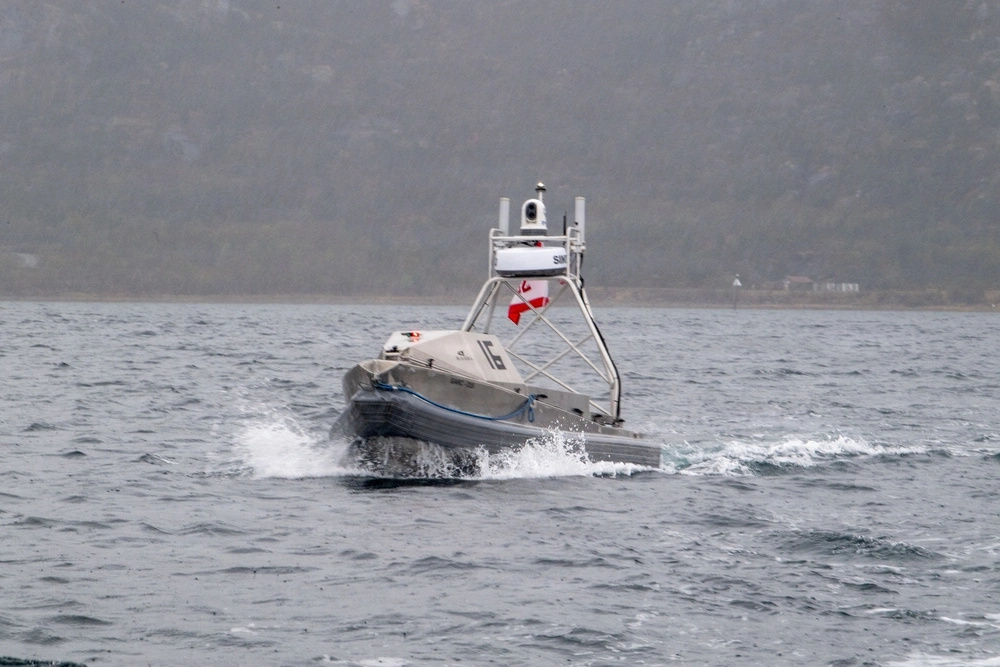
In July 2026, three Corsair uncrewed surface vessels struck a submarine and ship maintenance facility at Iran’s Bandar Abbas naval base, the first time American forces employed sea drones in combat.1 Ten weeks later, on September 30, Secretary of War Pete Hegseth stood at Quantico and announced the Autonomous Warfare Command (AUTOWARCOM), “a new four-star combatant command with service-like authorities built to scale autonomous and robotic capabilities across the joint force.”2
The command is targeted to stand up on October 1, 2027, and it needs legislation to get there.3 Until then, an interim effort called Project Agincourt, led by Defense Innovation Unit (DIU) director Owen West and Navy SEAL Senior Chief Max Strasiser, will prototype what Hegseth called “warfighting acquisition, not just acquisition that happens at the Pentagon,” pairing operators with engineers and companies in fast build-test-field cycles.4 The implementing memo promises the new command its own manpower, budget, and acquisition authorities, and it directs each military department to create occupational specialties for autonomous warfare.5
AUTOWARCOM is the newest layer on a stack the Pentagon assembled quickly this year. In June, Hegseth created a Direct Reporting Portfolio Manager for Unmanned Systems (DRPM-UxS) under Deputy Secretary Steve Feinberg, with milestone decision authority over Group 1–3 drones, ground and maritime drones, counter-drone systems, and autonomy software.6 The office took in the Defense Autonomous Warfare Group (DAWG), the Replicator successor housed at U.S. Special Operations Command; Joint Interagency Task Force 401, the counter-drone task force; and DIU.7 The services kept their largest programs, including the Air Force’s Collaborative Combat Aircraft (CCA) and the Navy’s MQ-25, MQ-4C, and medium unmanned surface vessel.8 U.S. Southern Command stood up its own theater-level Autonomous Warfare Command in April.9 The Senate’s fiscal 2027 defense bill would permit a separate four-star command that would “integrate, and go fast, and transition the force generation of unmanned systems to the services sometime in the future.”10
The money has not caught up. The fiscal 2027 request sought $54.6 billion for DAWG, up from about $225 million the year before, with $53.6 billion riding on a reconciliation bill. Three congressional committees each marked $1 billion and took no action on the rest.11
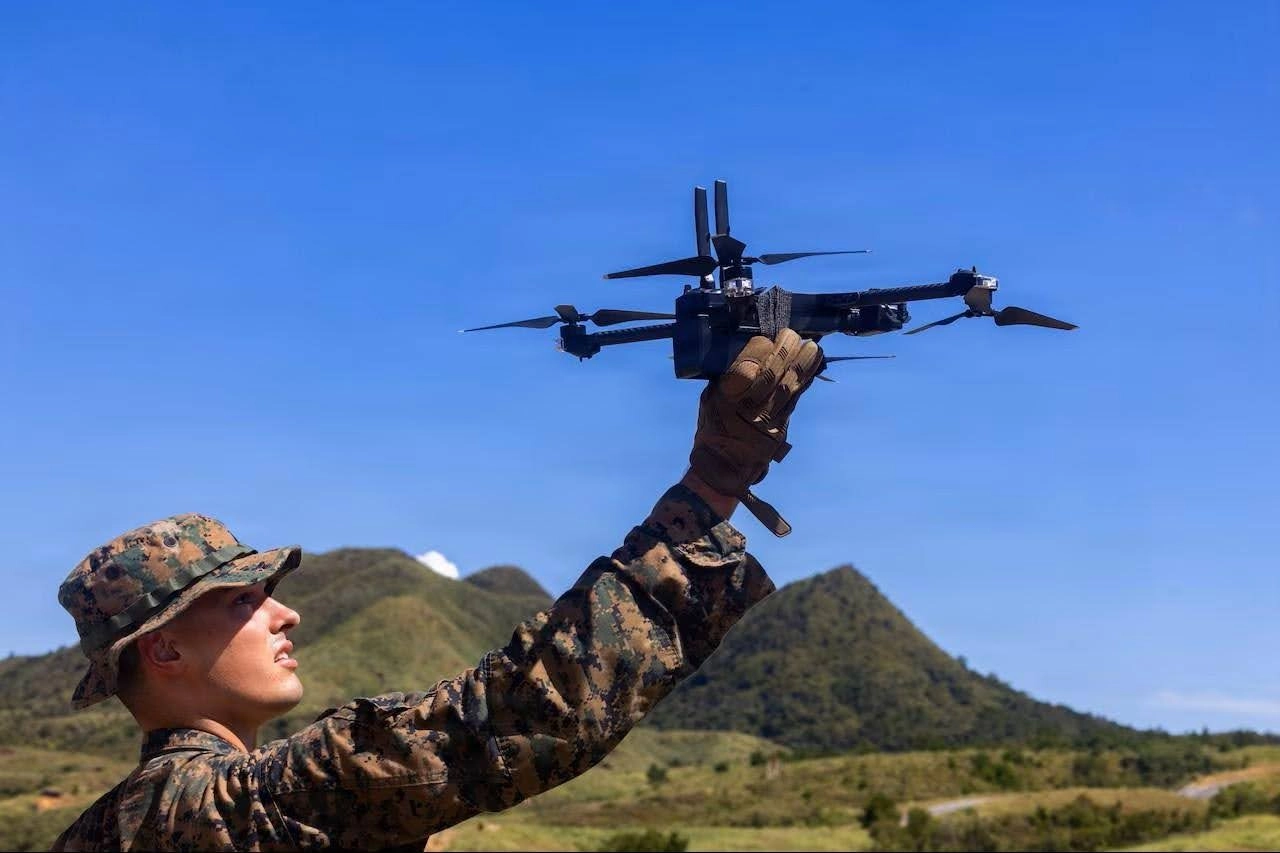
The services are not waiting. The Army ran a 600-soldier Unmanned Assault Battalion in Europe for less than a year, then shut it down in favor of pushing one-way attack drones to every squad by the end of fiscal 2026. Its limiting factor, officers say, is training operators, not hardware.12 The Marine Corps’ Ground Combat Element 2040 plan puts counter-drone defenses and organic precision strike in the rifle squad by 2030.13 The Navy plans more than 30 medium and thousands of small uncrewed surface vessels in the Indo-Pacific by 2030.14 The Air Force treats CCA as its autonomous future.15 None of them is building a drone branch. They treat small drones as munitions and large drones as aircraft and ships.
A Test for a New Functional Command
That leaves the useful question for anyone trying to anticipate AUTOWARCOM: what can it do that the services do not already provide? The United States has built functional combatant commands before, and each answered that question differently. U.S. Strategic Command (STRATCOM) shows what a functional command does with service-provided forces and almost no money. U.S. Cyber Command (CYBERCOM) shows how “service-like” authority arrives, and how slowly. U.S. Transportation Command (TRANSCOM) shows how a functional command shares a scarce pool across theaters while the services keep their own organic assets.
Each case is measured on three questions. Who owns the forces? Who controls the money? How does the command reach the geographic combatant commands (GCCs) that actually fight? U.S. Special Operations Command (SOCOM), the only combatant command with service-like authority written into statute, appears throughout as a guide to how AUTOWARCOM may buy and deploy.
Case 1. STRATCOM: Influence Without a Budget
STRATCOM was created in 1992, when Strategic Air Command was deactivated.16 It commands the most consequential forces in the arsenal and owns almost none of them. The Air Force provides ICBMs and bombers and the Navy provides ballistic missile submarines. STRATCOM’s own budget authority is “limited,” mostly operations and maintenance for its headquarters and mission support. Its leverage is requirements: the commander “develops operational and planning requirements for U.S. nuclear forces and the NC3 system.”17
STRATCOM has also served as the department’s incubator. It carried the missions that now belong to U.S. Space Command, and CYBERCOM was born inside it in 2009 as a subordinate command before becoming a combatant command in its own right in 2018.18
The STRATCOM case sets AUTOWARCOM’s floor. A functional command with service-provided forces and no money can still act outside the services’ lane through requirements, standards, and integration. For autonomy, that means the orchestration layer: the software that tasks drones from many vendors at once. DAWG’s $100 million prize challenge for exactly that layer exists because Replicator failed at it.19 The case also predicts a trajectory. Functional commands accumulate missions and then shed them, and the Senate’s version of this command is written to shed force generation back to the services.
Case 2. CYBERCOM: Service-Like, Eventually
CYBERCOM is the template the Pentagon’s own language points to. Its operational force is the Cyber Mission Force, 133 teams authorized in 2012 that the services man, train, and equip, then present to the command through Army Cyber Command, Fleet Cyber Command, 16th Air Force, and Marine Forces Cyberspace Command.20 The services also kept organic cyber forces outside CYBERCOM’s control: the Army’s 11th Cyber Battalion for close-access and radio-frequency effects, Marine Expeditionary Force Information Groups, and Navy non-kinetic effects teams afloat.21
For more than a decade, CYBERCOM employed teams it did not build. The services rotated people out, trained to different standards, and paid cyber operators differently. In fiscal 2024, Congress gave the command enhanced budget control over Cyber Mission Force budgets, acquisition, capability integration, and training. “We now have a set of authorities and we’re collaborating as a service-like organization,” then-commander Gen. Timothy Haugh said.22 The follow-on reform, Cybercom 2.0, still leaves the services responsible for manning, training, and equipping.23 It was costed at $956 million to start; the fiscal 2027 budget gives it less than $75 million.24
“Service-like” is CYBERCOM’s phrase, and the CYBERCOM case predicts AUTOWARCOM’s middle path: budget and acquisition control over a joint layer, with the services still owning the people. Two warnings carry over. Authority arrived only after years of readiness problems, and reform was announced, then underfunded. AUTOWARCOM is being promised its authority up front, but its funding gap is dozens of times larger than Cybercom 2.0’s. The organic-cyber precedent carries over too. It survived because close-access effects cannot wait on a functional command’s queue, and a squad’s first-person-view strike is the same kind of problem.
SOCOM shows where that authority could go next. Congress created SOCOM in 1986 and wrote its authorities into 10 U.S.C. §167. It organizes, trains, and equips its own forces and prepares its own budget, and an assistant secretary, ASD(SO/LIC), sits above it “for special operations-peculiar administrative matters,” acting much like a service secretary.25 Its money comes through Major Force Program 11 (MFP-11), a dedicated appropriation for “equipment, material, supplies, and services required for special operations missions for which there is no Service-common requirement,” run by SOCOM’s own acquisition executive.26 The services still pay for what is common. DAWG already buys through MFP-11, and critics warned from the start that housing it in the special operations community risked keeping the capability there.27
The SOCOM model works because special operations forces are small and distinct, so the line between SOF-peculiar and service-common is easy to draw. For drones, that line is moving the wrong way. When every Army squad carries one-way attack drones, what counts as “autonomy-peculiar”? Draw the line around long-range attack mass, swarm packages, and orchestration software, and AUTOWARCOM gets an MFP-11 analog the services can live with. Draw it around small drones, and AUTOWARCOM is buying the services’ ammunition.
Case 3. TRANSCOM: A Common Pool and Organic Exceptions
TRANSCOM, established in 1987, is the military’s primary logistics command. It works through three service components: the Air Force’s Air Mobility Command, the Navy’s Military Sealift Command, and the Army’s Military Surface Deployment and Distribution Command.28 Its forces are service-provided, like STRATCOM’s, but its money works differently from any other command’s. Through the Transportation Working Capital Fund (TWCF), the services and agencies “place orders for transportation services, paying into the TWCF out of their own appropriated funds,” roughly $9.5 billion a year. When military lift runs short, the Civil Reserve Air Fleet pulls in commercial airliners; it has been activated three times since 1990.29
TRANSCOM never took every truck, boat, and airplane. The services kept organic lift for fights only they can see coming. When the Army moved in 2019 to divest much of its watercraft fleet, the House moved to block it pending an independent study, because those vessels can “deposit their cargos right on a beach” in island chains with no port.30 More recently, the Senate moved to codify TRANSCOM’s global responsibility for contested-logistics risk. Its commander, Gen. Randall Reed, says the joint force is now “fighting to move, instead of moving to fight.”31
The TRANSCOM case is the best predictor of how AUTOWARCOM will touch a theater. Long-range autonomous mass is a scarce common-user pool, like strategic lift, and it will be apportioned across GCCs by priority; under that model, INDOPACOM wins most allocation fights. Squad drones are organic lift, because the last tactical mile cannot wait in a global queue. The funding model may matter even more. DRPM-UxS already runs the department’s unmanned systems marketplaces.32 A working-capital arrangement, in which services and GCCs order drones from a joint marketplace with their own money, would give AUTOWARCOM leverage without a giant appropriation. A drone analog to the Civil Reserve Air Fleet, contracted surge production from commercial lines, would answer the munitions-like burn rate the Army is already seeing in exercises.
There is also a direct collision, not just an analogy. The fiscal 2027 unmanned request includes $13.5 billion for “commercially integrated logistics.”33 No document yet says whether an autonomous cargo drone in theater belongs to TRANSCOM, the owning service, or AUTOWARCOM.
What Geographic Combatant Commanders Should Expect
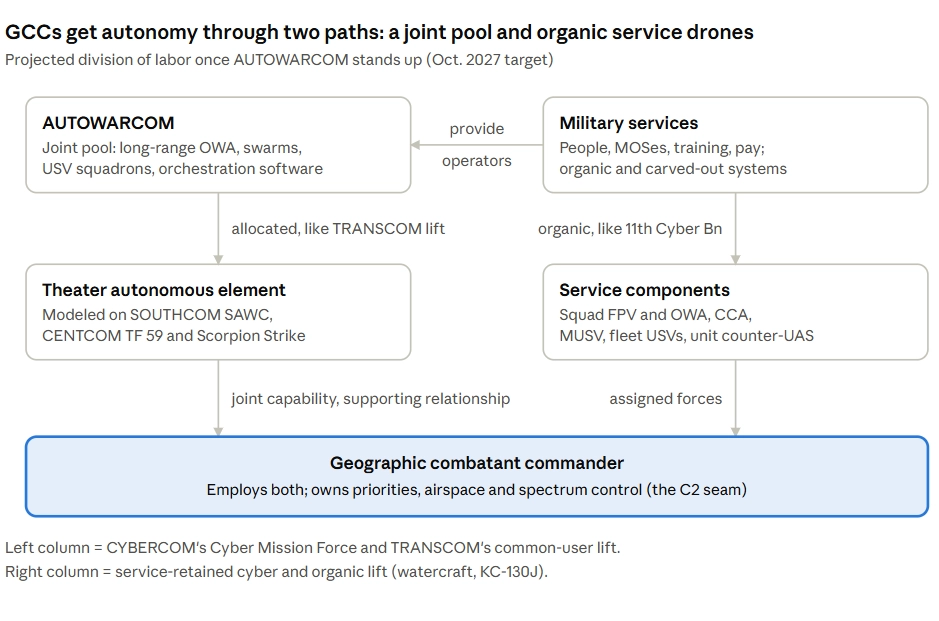
Taken together, the three cases point to a supporting command, not a new owner of the fight. The memo’s stated mission is to “define joint needs and integrate Service-provided forces in support of geographic combatant commanders.”34 GCC commanders should expect four things.
- The first is an advocate. A four-star who defines joint needs gives a theater’s unmanned shortfalls a voice in the budget, the way SOCOM speaks for theater special operations requirements.
- The second is a theater element. SOCOM offers the clearest deployment model. Theater special operations commands are “sub-unified commands under their respective Geographic Combatant Commanders.” SOCOM has held combatant command of them since 2013, but “the GCCs continue to have operational control over the TSOCs and all special operations in their respective theaters.”35 Central Command already runs Task Force 59, the one-way attack drone squadron Task Force Scorpion Strike, and the multinational Task Force Falcon Strike, and SOUTHCOM has its own autonomous warfare command.36 Expect AUTOWARCOM to formalize one such element per theater on the TSOC pattern: AUTOWARCOM builds and owns it, and the GCC directs it.
- The third is a partner channel. SOCOM holds operational funding authorities no other command has. Under 10 U.S.C. §127e, the department may spend up to $100 million a year supporting foreign and irregular forces that enable U.S. special operations against terrorism.37 Falcon Strike is multinational, and SOUTHCOM’s command is built around partner nations. If AUTOWARCOM wants allies employing American drones in coalition formations, it will need a comparable authority, and none has been proposed in coverage to date.
- The fourth is a seam. Thousands of drones need airspace and spectrum control, and retired Lt. Gen. David Deptula warns that a separate command would “introduce a new seam in command and control precisely when modern warfare demands tighter integration across domains.”38 That seam will sit with the GCC and its air component, not with AUTOWARCOM.
Familiar Parts, New Purpose
| Command | Forces | Money | Reach to GCCs | What AUTOWARCOM Borrows |
|---|---|---|---|---|
| STRATCOM | All service-provided | Headquarters O&M only | Global; supported and supporting | Influence through requirements and integration |
| CYBERCOM | Service-provided teams; services keep organic cyber | Enhanced budget control since FY24 | Joint headquarters aligned to each GCC | “Service-like” control of a joint layer |
| TRANSCOM | Service components; services keep organic lift | Working capital fund; customers pay | Apportioned common-user lift | A shared pool, a marketplace, commercial surge |
| SOCOM (lens) | Organizes, trains, equips its own | MFP-11 for SOF-peculiar items; §127e | TSOCs under GCC operational control | A dedicated budget line and the TSOC deployment model |
AUTOWARCOM resembles its predecessors in the ways that matter most to a GCC. Like STRATCOM, its forces will mostly be service-provided. Like CYBERCOM, its service-like authority will cover a joint layer while the services keep the people and the training pipelines. Like TRANSCOM, it will manage a scarce common pool across theaters while the services keep organic systems at the edge. And like all three, it will employ through the GCCs, not around them. From SOCOM it may borrow a dedicated budget line and a theater deployment model, if Congress agrees to draw the “peculiar versus common” line.
It is unique in four ways. It is the first combatant command organized around a class of technology rather than a mission, region, or domain, which is the heart of the critics’ case.39 It fuses acquisition with operations by design; no predecessor was told to run “warfighting acquisition” alongside frontline units.40 Its main product is consumable: drones are expended like munitions, so its real readiness measure is production and replenishment, not unit status reports. And it is being built before its money. Its predecessors gained authority after their forces existed. AUTOWARCOM is receiving authority first and still lacks the appropriation.
Four signals will show which command it becomes. If it receives units and a dedicated appropriation, it becomes SOCOM. If it receives a budget line and the orchestration layer but no units, it becomes CYBERCOM after 2024. If it runs a marketplace that services and GCCs pay into, it becomes TRANSCOM. If it receives none of these, it becomes STRATCOM: influential, integrative, and dependent on the services. The 30-day plan of action due this fall, the fiscal 2027 defense bill conference, and the fate of reconciliation will decide which.
References
1. “CENTCOM Has Become a Battle Lab for Unmanned Systems,” Navy CRF, September 22, 2026, https://www.navycrf.com/2026/09/22/centcom-has-become-a-battle-lab-for-unmanned-systems/.
2. “Vision for New Autonomous Warfare Command Laid Out by Pentagon,” The War Zone, accessed October 1, 2026, https://www.twz.com/news-features/vision-for-new-autonomous-warfare-command-laid-out-by-pentagon.
3. “Hegseth Announces New Four-Star Command for Autonomous Warfare,” Military Times, September 30, 2026, https://www.militarytimes.com/news/your-military/2026/09/30/hegseth-announces-new-four-star-command-for-autonomous-warfare/; “Pentagon Unveils Four-Star Autonomous Warfare Command,” AeroTime, accessed October 1, 2026, https://www.aerotime.aero/articles/pentagon-autonomous-warfare-command-drones-ai.
4. “U.S. Creates New Autonomous Warfare Command to Fuse and Enhance Military Drone Ops,” DefenseScoop, September 30, 2026, https://defensescoop.com/2026/09/30/hegseth-announces-autonomous-warfare-command/.
5. “Hegseth Unveils Project Meridian & 5 Other DOW Initiatives,” GovConWire, accessed October 1, 2026, https://www.govconwire.com/articles/hegseth-project-meridian-dow-initiatives; “Pentagon Unveils Four-Star Autonomous Warfare Command.”
6. “New Pentagon Unmanned Czar Will Oversee Most Drone Programs, Memo Reads,” USNI News, accessed October 1, 2026, https://news.usni.org/?p=123532.
7. “The Pentagon’s New Drone Czar: How DRPM-UxS Answered Congress’s Push for a Robotics Combatant Command,” Inside Unmanned Systems, accessed October 1, 2026, https://insideunmannedsystems.com/the-pentagons-new-drone-czarhow-drpm-uxs-answered-congresss-push-for-a-robotics-combatant-command/.
8. “New Pentagon Unmanned Czar.”
9. U.S. Southern Command, “SOUTHCOM Establishes Autonomous Warfare Command,” press release, accessed October 1, 2026, https://www.southcom.mil/News/PressReleases/Article/4466083/southcom-establishes-autonomous-warfare-command/.
10. “Senators Want a New Robot Warfare-Focused Combatant Command,” Defense One, June 2026, https://www.defenseone.com/policy/2026/06/senators-want-new-robot-warfare-focused-combatant-command/414133/; “Senate Pushes DOD to Create New Combatant Command for Unmanned Systems,” DefenseScoop, June 11, 2026, https://defensescoop.com/2026/06/11/senate-pushes-dod-to-create-new-combatant-command-for-unmanned-systems/.
11. “DAWG Asked for $54.6B. Three Committees Wrote Down $1B,” Defense-Aerospace.com, accessed October 1, 2026, https://www.defense-aerospace.com/dawg-54b-requested-1b-written-down/.
12. “As Experimental Drone Battalion Ends, Army Aims to Push Drones to Every Squad,” Military Times, September 18, 2026, https://www.militarytimes.com/news/your-military/2026/09/18/as-experimental-drone-battalion-ends-army-aims-to-push-drones-to-every-squad/.
13. “Marines Push Drones and Defenses to Squad Level to Prep Ground Forces for Tech-Heavy Battlefield,” Stars and Stripes, August 28, 2026, https://www.stripes.com/branches/marine_corps/2026-08-28/marine-ground-forces-drones-defense-22684649.html.
14. “Navy to Deploy Thousands of Unmanned Surface Vessels to the Indo-Pacific by 2030,” USNI News, April 21, 2026, https://news.usni.org/2026/04/21/navy-to-deploy-thousands-of-unmanned-surface-vessels-to-the-indo-pacific-by-2030.
15. “Hegseth Unveils New Autonomous Warfare Command in ‘State of the Force’ Address,” Air & Space Forces Magazine, accessed October 1, 2026, https://www.airandspaceforces.com/hegseth-drones-autonomous-warfare-command-state-of-the-force/.
16. Congressional Research Service, Defense Primer: U.S. Strategic Command (STRATCOM), IF12981 (Washington, DC: Congressional Research Service, updated March 25, 2026), https://www.everycrsreport.com/files/2026-03-25_IF12981_ef920cd5743a2b15e541c36c24b573563eea9918.html.
17. Congressional Research Service, Defense Primer: STRATCOM.
18. Congressional Research Service, Defense Primer: STRATCOM; U.S. Cyber Command, “Our History,” accessed October 1, 2026, https://www.cybercom.mil/About/History/.
19. “Defense Autonomous Warfare Group (DAWG),” GlobalSecurity.org, accessed October 1, 2026, https://www.globalsecurity.org/military/agency/dod/dawg.htm.
20. U.S. Cyber Command, “Our History”; Congressional Research Service, Analysis of a Potential Cyber Military Service, IF13291 (Washington, DC: Congressional Research Service), accessed October 1, 2026, https://www.everycrsreport.com/reports/IF13291.html.
21. “New DOD Doctrine Officially Outlines and Defines ‘Expeditionary Cyberspace Operations,’” DefenseScoop, May 12, 2023, https://defensescoop.com/2023/05/12/new-dod-doctrine-officially-outlines-and-defines-expeditionary-cyberspace-operations/.
22. “Following New Authorities, Cybercom Says Making Progress Correcting Readiness,” DefenseScoop, July 31, 2024, https://defensescoop.com/2024/07/31/following-new-authorities-cybercom-says-making-progress-correcting-readiness/.
23. “Senior DOD Officials Back Cybercom 2.0, as Cyber Force Debate Continues to Churn,” DefenseScoop, January 30, 2026, https://defensescoop.com/2026/01/30/cyber-force-cybercom-katie-sutton-trump-administration/.
24. “The Pentagon’s Cyber Reform Effort Stumbles Out the Gate,” DefenseScoop, May 18, 2026, https://defensescoop.com/2026/05/18/pentagon-cyber-reform-effort-stumbles-out-the-gate/.
25. Andrew Feickert, U.S. Special Operations Forces (SOF): Background and Issues for Congress, RS21048 (Washington, DC: Congressional Research Service, updated February 9, 2024), https://www.everycrsreport.com/files/2024-02-09_RS21048_9672fa0dbefef5b812ed67bc8a43ad7307548227.html.
26. Congressional Research Service, United States Special Operations Command Acquisition Authorities, R45252 (Washington, DC: Congressional Research Service, July 9, 2018), https://www.everycrsreport.com/reports/R45252.html.
27. “Defense Autonomous Warfare Group (DAWG).”
28. Luke A. Nicastro and Cameron M. Keys, Defense Primer: United States Transportation Command, IF11479 (Washington, DC: Congressional Research Service, updated December 12, 2024), https://www.everycrsreport.com/files/2024-12-12_IF11479_625d3a9a863438b870cda9a6e2aa1d57e022f801.pdf.
29. Nicastro and Keys, Defense Primer: United States Transportation Command.
30. “Congress Demanded the Army Put Its Plans to Gut Its Underappreciated Naval Fleet on Hold,” The War Zone, August 5, 2019, https://www.twz.com/29283/congress-demanded-the-army-put-its-plans-to-gut-its-underappreciated-naval-fleet-on-hold.
31. “Transportation Command Could See Expanded Contested Logistics Responsibilities Next Year,” DefenseScoop, August 11, 2025, https://defensescoop.com/2025/08/11/transportation-command-gen-randall-reed-contested-logistics-transcom/.
32. DroneXL, report on DRPM-UxS authorities, July 1, 2026, https://dronexl.co/2026/07/01/pentagon-drone-czar-drpm-uxs-diu/.
33. “The Pentagon’s New Drone Czar.”
34. “Vision for New Autonomous Warfare Command.”
35. Feickert, U.S. Special Operations Forces (SOF).
36. “CENTCOM Has Become a Battle Lab”; U.S. Southern Command, “SOUTHCOM Establishes Autonomous Warfare Command.”
37. Support of Special Operations to Combat Terrorism, 10 U.S.C. § 127e, https://www.law.cornell.edu/uscode/text/10/127e.
38. Air & Space Forces Association, “AFA Opposes Proposed Robotic and Autonomous Command,” accessed October 1, 2026, https://www.afa.org/afa-opposes-proposed-robotic-and-autonomous-command/.
39. “Critics Slam Idea to Create US Combatant Command for Robots,” Responsible Statecraft, accessed October 1, 2026, https://responsiblestatecraft.org/ai-command/.
40. “U.S. Creates New Autonomous Warfare Command.”